Product Overview
Galvanized steel sheet begins as carbon steel that passes through a bath of molten zinc, so the coating bonds to the steel instead of sitting on it like a paint film. The zinc takes the weather first: it dulls, slowly consumes itself, and keeps moisture away from the steel underneath. That is why a bare galvanized elevation can be left alone for years where painted mild steel would already be asking for a fresh coat.
We supply flat metal sheets to fabricators, cladding contractors, fit-out teams and engineers who need a rigid panel that holds its face outdoors. Most of it goes into exterior work — industrial walls, roofing and metal siding sheets on factories, warehouses and plant buildings — and the same sheet runs inside on framed partitions, door and partition sets and office interior decoration schemes where a hard, non-combustible face is wanted.
Set against uncoated mild steel, the difference appears later: one wall is still flat and grey while the other has rust bleeding from every fixing. Set against stainless steel, the difference appears on the invoice. On large industrial elevations, where the area rather than the finish drives the budget, that is usually the deciding comparison.
Sheets leave us flat and stacked, ready to be cut, drilled or roll formed into the profile your drawing calls for.
Zinc Coating and Surface Finishes
Every sheet starts in the zinc bath. Hot-dip galvanizing immerses the steel in molten zinc, and the coating that forms is bonded to the surface as a series of zinc-iron layers rather than applied on top of it. That bond is what allows the sheet to be cut, drilled and roll formed without the protection peeling back from the cut. Electroplating applies a thinner zinc layer electrolytically; it suits light indoor work such as office interior decoration, while hot-dip is the route for anything that faces weather.
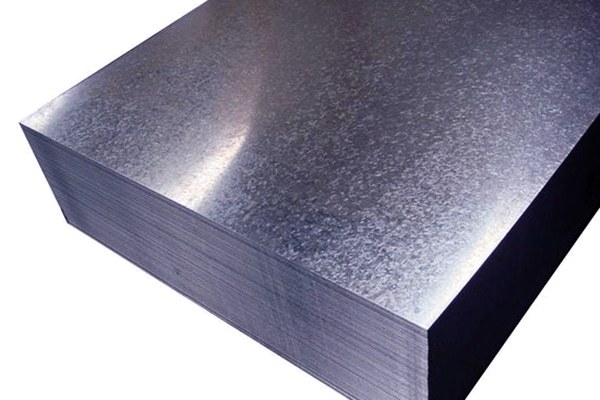
What the bath leaves behind is spangle — the crystalline pattern that forms as the zinc cools, visible as a faint faceted texture across the face. Some projects want it, because the wall then reads as galvanized rather than as painted grey; others want it gone. A matte finish evens the surface and gives an easier base for paint; a painted finish adds colour and a second barrier over the zinc; a coated finish adds a further protective layer where the exposure is harder.
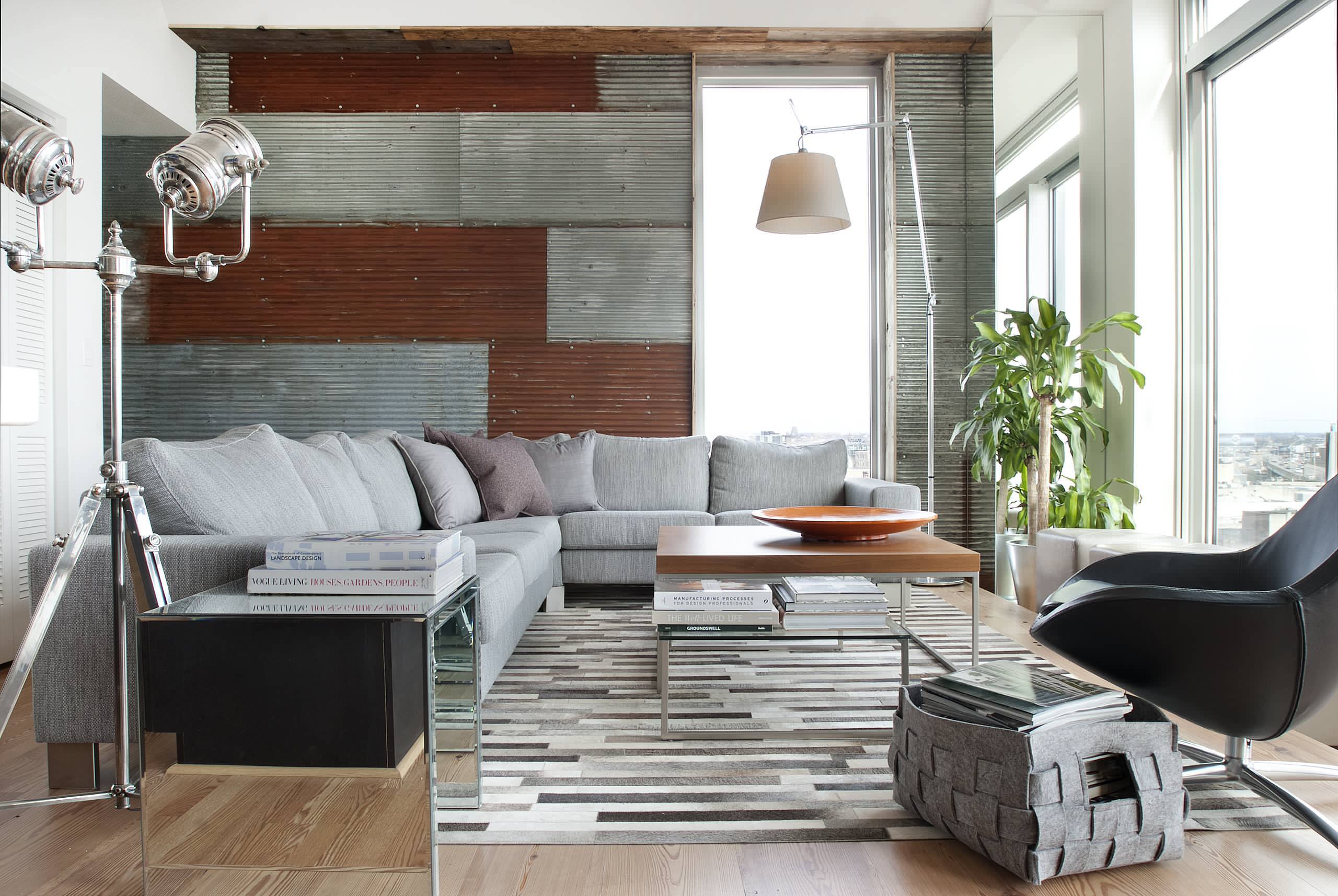
Finish and profile are chosen together. On metal corrugated sheets the profile throws its own shadow, and the finish decides how much of the crystalline pattern still shows in raking light. The painted and coated routes are also what let the sheet serve as decorative metal sheets on a visible interior wall, where the face is part of the design rather than simply a weather skin.
Judge all of this from a physical sample, not from a photograph. Tone, pattern and sheen shift with the light, and the sample you approve becomes the reference for the whole run.
Specifications
| Item | Specification |
|---|
| Base material | Carbon Steel with Zinc Coating |
| Standard dimensions | 1220×2440 mm, 1500×3000 mm (custom sizes available) |
| Thickness range | 0.8–3.2 mm |
| Surface finish | Spangle, Matte, Painted, Coated |
| Manufacturing process | Hot-dip galvanizing, Roll forming |
| Fire rating | Class A (non-combustible) |
| Environmental rating | Durable, Long service life |
| Installation methods | Mechanical fixing, Welding, Framing |
| Maintenance | Periodic inspection in outdoor environments |
| Typical applications | Exterior panels, Industrial walls, Doors & partitions |
| Sheet form | Flat sheet, stackable and cuttable on site |
| Edge protection | Zinc coating continues to protect cut and drilled edges |
Thickness and Sheet Size Selection
- The lightest sheets go into profile. Thin gauges are the ones that run through a roll former into corrugated metal sheets, and the ones used for interior linings, soffits and cabinet backs where the sheet only has to hold a flat face and a finish.
- Mid-range sheets carry a facade or a partition. A mid gauge stays flat between supports, takes a knock without denting through, and is still light enough for two people to lift a full sheet into place.
- The heaviest sheets take impact. Industrial walls where pallets, vehicles or equipment come close, and elevations running across a wide fixing span, are where the thicker metal sheets earn their cost — fewer supports, a flatter plane and less drumming in wind.
- Measure the finished opening, not the flat. Work from the finished run, including the lap and fixing allowance on your detail. For a partition or a set of commercial fire rated doors, work from the frame opening and from the way the sheet returns into the frame.
- Cut to your cutting list. Send the list and we match sheet sizes to it, so offcuts and site cutting both come down. If a profile is involved, confirm which way the corrugation runs before anything is cut.
- Check the handling route before you fix the size. A longer sheet needs a lift, a clear stair or a crane. On a tight site, two shorter sheets that lap can be easier to place than one long one.
Sheet Format and Modular Build
A galvanized sheet is a flat sheet first. Corrugated metal sheets, ribbed panels and folded trims are all formed from it, so one material becomes a liner, a facade panel or a flat door face depending on what happens after it leaves the stack.
Roll forming runs the flat sheet through a set of rolls that bend it into a continuous profile. The bend does two jobs: it stiffens the panel so a relatively thin sheet spans further between supports, and it gives water a defined path down the wall. On a long elevation that combination is what allows wider support spacing without the wall looking restless.
Flat sheets go where a true plane matters — partition faces, door casings, linings, cabinet backs and decorative metal sheets. They can be cut, notched and drilled on site with hand tools, and the zinc keeps protecting the fresh edge, so a sheet can be adjusted to the opening rather than the opening being built around the sheet.
The same property is what makes the material easy to work into framed and modular wall systems. A panel can be lifted out to reach a service, replaced on its own, or re-cut when a partition moves, which is why refurbishment work often keeps the existing sheets rather than sending them to waste.
Storage matters more than most sites expect. Stack sheets clear of the ground, keep them dry and let air move between them; sheets left wet in a closed stack develop a white storage stain across the face, and that stain is avoidable. Brush off drilling swarf the same day, because steel filings rust on their own and mark the coating.
Installation and Fixing Methods
- Set out the frame or substrate before the first sheet goes up. Support spacing follows the engineer's drawing, and every sheet needs support at its edges plus enough intermediate support to keep a flat face between fixings.
- Choose the fixing method the detail calls for: mechanical fixing for most cladding and linings, welding where a continuous connection is drawn, framing where the sheet forms part of a partition or a door surround.
- Fix mechanically with self-drilling screws and sealing washers, driven square to the face and not over-tightened. An over-driven screw dishes the sheet and traps water around the washer.
- Weld only where the drawing specifies it. Welding burns the zinc back from the seam, so clean the weld and dress the zone with a zinc-rich repair coat before the joint is closed up.
- Frame the partitions and commercial fire rated doors: the sheet is fixed back to a stud or frame system, set plumb and square, so the door reveal and the wall line stay true.
- Clear the swarf. Steel filings left on a galvanized face rust on their own and stain the coating, so brush or blow them off the same day, especially on a visible elevation.
- Check laps and falls on corrugated metal sheets before handover — each lap should shed water away from the building, not into it.
Exterior Facade and Metal Siding Applications
- Factories, warehouses and plant buildings. The bulk of our sheet goes onto industrial walls as metal siding sheets: large flat areas, long runs between openings, and a surface that will not need repainting every few years.
- Industrial roofing and gutters. Roof sheeting, gutter liners and edge trim use the same coating system, which keeps the whole envelope on one specification instead of two.
- Profiled elevations. Where the design wants shadow and depth, the sheet is roll formed into metal corrugated sheets profiles; the profile stiffens the panel and gives water a path down and away from the wall.
- Canopies, screens and enclosures. Plant screens, bin stores and service enclosures use the sheet for its rigidity and its non-combustible class rather than for appearance.
- Exposed and aggressive sites. Coastal air, heavy rainfall and industrial atmospheres all shorten the life of any coating. Tell us where the building sits when you order, so the finish route and the inspection rhythm are chosen for that exposure rather than for a mild inland site.
Commercial Interior Fit-Out
- Framed partitions and wall linings. The sheet gives a rigid, flat face on a stud frame and can be painted to the scheme or left grey. It does not swell with humidity the way gypsum or timber does, which matters in a building that runs warm and damp.
- Door and partition sets. Many commercial doors are built with a sheet face or sheet casing over a frame; the sheet takes paint, takes a knock at trolley height and can be replaced without rebuilding the opening.
- Rated openings. Where the door schedule names commercial fire rated doors, the sheet's part in it is simply that it is non-combustible and stays that way.
- Office interior decoration schemes. Painted panels, exposed mill finish and mixed-material walls all work with this sheet; in a fit-out it is often the flat, quiet surface that lets a warmer material do the talking.
- Refurbishment without demolition. Panels can be taken off, services run and the same panels put back. A wall can be shortened, extended or re-faced without a skip on the frontage.
- What the sheet does not do. It is a facing and a panel, not a structural member. Frame design, load paths and the fixing schedule belong with your project engineer, and we supply the sheet to that drawing.
Performance and Service Life
Galvanized metal sheets age differently from a painted panel. The surface dulls to a uniform grey as it weathers, and that dulling is the coating doing its job — the zinc is reacting so the steel underneath does not. Nothing needs to be done about it, and on an industrial elevation the change is usually welcome, because a uniform grey wall hides handling marks better than a fresh painted one.
Outdoors is where inspection earns its keep. Walk the elevation on a routine cycle, more often on an exposed facade than on a sheltered one: check that fixings are tight, look at cut edges and around penetrations, clear leaves and debris from the laps of metal corrugated sheets and from gutters, and touch in any area where the coating has been mechanically damaged with a zinc-rich product. A small repair made early stays small.
Indoors the sheet is largely immune to what ages other linings. It does not swell with humidity, it does not delaminate and it can be wiped down — useful in service corridors, plant rooms and back-of-house areas where a wall gets washed rather than decorated.
Tone across a run is settled at the start, not at the end. Approve one sample, keep it on site as the reference and order the whole elevation against it; a wall supplied in two batches and two finishes will show the join, especially in raking light.
Ordering and Delivery
- Send the drawings or cutting list marked up with where the sheets sit — an elevation for metal siding sheets, a partition or door schedule for interior work.
- Confirm sheet size and gauge against the cutting plan, including the direction of any profile, before the run is released.
- Approve a physical sample of the finish. Spangle, matte, painted and coated read differently in daylight — most of all on decorative metal sheets, where the face is the finished surface — and the approved sample becomes the reference for the whole order.
- Confirm packing and marking: flat stacks, edge protection, and a bundle the site lift or crane can handle.
- Confirm the documents the project needs — the specification sheet, which is also available to download, the packing list, and any compliance documents the contract names — so nothing is held up at customs or at the site gate.
- Confirm the delivery schedule and shipping terms with your sales contact before the order is released. The same contact can confirm current sample availability if you want to see the finish before committing.
Supply Chain & Delivery Assurance
Guangzhou Chuxin Import & Export works as the coordination point between your project and the suppliers who make it. We consolidate the categories a fit-out needs into a single order, match each specification to suppliers in our global procurement network, and follow it through sampling, pre-shipment inspection, export documentation and cross-border delivery to the Americas, Europe, Southeast Asia and the Middle East. Custom sizing and OEM coordination are arranged around your drawings and programme, and one contact tracks the order from approved sample to arrival, so a multi-category package moves on one schedule.
FAQ
Can you supply galvanized steel sheets in custom sizes and thicknesses?
Yes. Standard sheets are 1220 × 2440 mm and 1500 × 3000 mm, and we cut to your dimensions, with thicknesses across the 0.8–3.2 mm range. Send the cutting list with the enquiry and we will match sheet sizes to it, which keeps offcuts down and saves cutting on site.
What surface finishes are available, and which one suits my project?
Spangle, matte, painted and coated. Spangle is the natural crystalline finish straight from the zinc bath and suits industrial elevations; matte gives an even, low-sheen face that is easier to paint and reads more uniformly across a long wall; painted and coated routes add colour and a second barrier for visible or exposed work. Ask for a physical sample before you commit — tone and pattern are much easier to judge in the hand.
Which fixing method do you recommend — mechanical fixing, welding or framing?
It depends on what the sheet is doing. Mechanical fixing with self-drilling screws and sealing washers is the usual choice for cladding and linings because it is fast and allows slight movement; welding suits a continuous connection drawn by the engineer, and the weld zone then needs cleaning and a zinc-rich repair coat; framing is used for partitions and door surrounds where the sheet is carried on a stud or frame system. Tell us the substrate and the exposure and we will confirm the detail with you.
Can these sheets be used for commercial doors and partitions?
Yes — doors and partitions are one of the main applications. The sheet forms the face or the casing, and it can be painted or left in a mill finish. Where a rated opening is involved, the fire performance of the finished door is certified by the door manufacturer; the sheet's contribution is that it is Class A non-combustible and adds no fuel to the assembly.
Will the sheets rust at cut edges and around fixings?
The zinc keeps protecting a cut or drilled edge galvanically, so a clean cut does not start a rust line the way a painted sheet would. Remove drilling swarf before it sits on the surface, and touch in cut edges with a zinc-rich product where the detail stays visible. Add those edges and the fixings to the routine inspection and any small repair stays small.
How does galvanized steel work inside an office fit-out?
It gives a rigid, non-combustible face for framed partitions, door and partition sets and wall linings, and it can be painted to the scheme or left with the spangle showing as an industrial detail. Unlike gypsum or timber it does not swell or soften if the building runs humid, and a panel can be taken off and refitted when services change.